
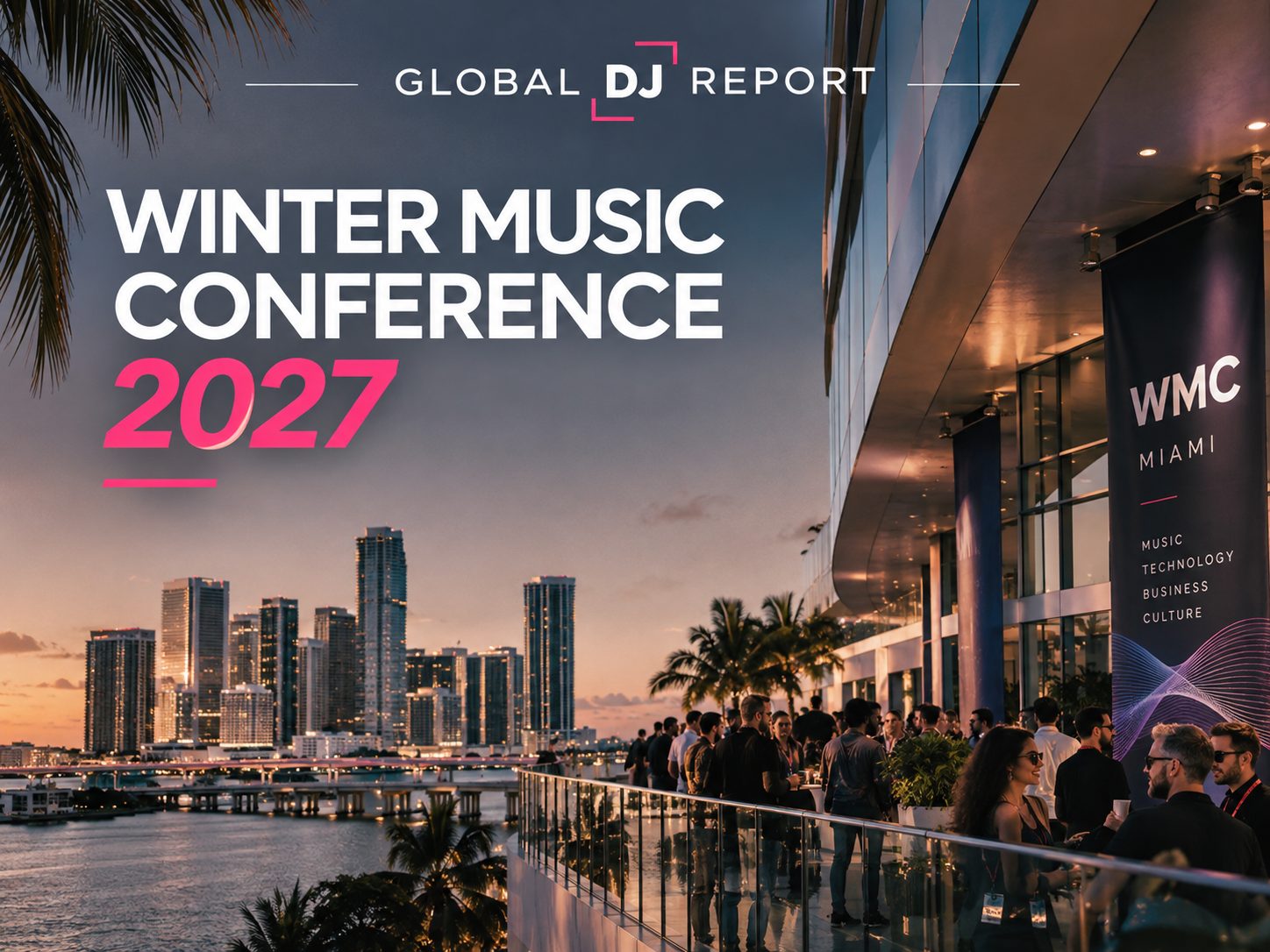
One of electronic music’s longest-running industry gatherings is preparing for another edition in Miami.
Winter Music Conference has unveiled the first wave of programming for its 37th edition, taking place from March 24 to March 26, 2027 at the Kimpton EPIC Hotel in downtown Miami.
The conference will once again run during Miami Music Week, bringing together artists, labels, promoters, technology companies, platforms and other figures from across the electronic music business.
But the first announcement also reveals something larger about where the industry is heading.
AI.
Artist discovery.
New generations of House music.
Technology.
Ticketing.
Creator tools.
The subjects being programmed for 2027 offer a snapshot of the conversations shaping electronic music right now.
The Industry Returns to Miami
Winter Music Conference has played an important role in dance music culture for decades.
Long before electronic music became part of the global mainstream, Miami served as an annual meeting point where labels could present records, DJs could build international relationships and promoters could discover new artists.
That function has changed over time.
Streaming replaced much of the physical promo culture.
Social media transformed artist discovery.
DJ software changed performance.
Data became central to marketing.
But the need for people inside the industry to meet one another never disappeared.
The 2027 edition continues that tradition with a structure divided between Industry and Creator tracks.
The distinction reflects the modern electronic music ecosystem.
Some people attend to discuss business.
Others want practical tools for making music and developing careers.
Increasingly, many artists need both.
Beatport Will Ask What the New House Rules Are
One of the first announced panels comes from Beatport.
The session is titled:
“The New House Rules: A Generation Redefining the Dance Floor.”
The title alone says a great deal about the current state of House music.
The genre is experiencing another period of transformation.
Tech House remains enormous.
Minimal and Deep Tech have expanded into larger venues.
UK Garage influences are appearing again.
Classic House references have returned.
Afro House has become increasingly global.
Younger producers are moving between styles without respecting the genre boundaries that shaped earlier generations.
The question is no longer whether House music is relevant.
It is what House music now means.
AI Moves to the Centre of the Conversation
Another major theme will be artificial intelligence.
Winter Music Conference has confirmed a keynote examining the implications of AI for the future of electronic music.
That subject could hardly be more current.
AI is already affecting production.
Music discovery.
Mastering.
Sample generation.
Stem separation.
Marketing.
Copyright.
And even the creation of entire tracks.
The debate has now moved beyond whether electronic music will use AI.
It already does.
The more difficult questions involve authorship and transparency.
When does AI remain a tool?
When does it become the creator?
Who owns the result?
How should streaming platforms identify AI-generated material?
These are no longer abstract problems.
They are becoming everyday industry issues.
ElevenLabs Joins the Speaker Ecosystem
The first speaker wave includes representatives connected to companies and platforms such as Beatport, Splice, DICE, Fever, Teletech, 1001Tracklists, Billboard and ElevenLabs.
That mix is particularly revealing.
Beatport represents electronic music retail and DJ culture.
Splice represents production and samples.
DICE and Fever represent ticketing and experiences.
1001Tracklists tracks what DJs are actually playing.
Billboard represents charts and the wider music business.
ElevenLabs represents a new generation of AI-driven audio technology.
Put together, those companies show how broad electronic music has become as an industry.
The ecosystem now extends far beyond records and clubs.
Creator Education Becomes More Important
The Creator track is also likely to become increasingly important.
Modern producers are expected to understand far more than music production.
They need to understand branding.
Distribution.
Publishing.
Social media.
Touring.
Contracts.
Marketing.
Data.
Sometimes even direct ticket sales.
The idea of the artist simply making music while someone else handles everything around it has become increasingly unrealistic for emerging acts.
Conferences therefore have a new role.
They are no longer simply places to network.
They can also become education centres for an industry where artists are increasingly expected to operate like small companies.
The A&R Pop-Up Expands
One of the most interesting elements returning from the 2026 edition is the A&R Pop-up Session.
After a successful first year, the programme will expand in 2027 into genre-focused mixers inside the Gear Hall.
Emerging producers will be able to connect directly with established labels, share demos and develop relationships with A&R teams.
That may sound relatively traditional.
In some ways, it is.
Electronic music used to depend heavily on moments like these.
A producer handed a record to a DJ.
A label owner heard a demo after a party.
A relationship began through one conversation.
Digital submission systems made the process faster.
They also made it less personal.
Thousands of demos can now arrive in a label inbox every month.
A physical meeting can therefore become unusually valuable.
Why Genre-Focused Sessions Matter
The decision to separate A&R networking into genre-focused sessions also makes sense.
Electronic music has become too broad for one generic demo room.
A Progressive House producer may have very little in common with someone making Hard Techno.
A Minimal producer may be targeting completely different labels from a Drum & Bass artist.
Genre-focused environments allow artists to meet companies that are actually relevant to their music.
That increases the possibility of useful conversations rather than simply creating more networking for its own sake.
Miami Music Week Remains an Industry Moment
Winter Music Conference takes place inside the wider Miami Music Week ecosystem.
That timing remains one of its greatest strengths.
Artists, agents, promoters, label teams and technology companies are already in the city.
Meetings happen during the day.
Showcases happen at night.
Records tested in clubs can become the subject of conversations the following morning.
The boundary between industry conference and music festival becomes extremely thin.
Few cities reproduce that environment as effectively as Miami.
From Record Deals to Technology Partnerships
The type of deals discussed at electronic music conferences has also changed.
In earlier eras, the central question might have been:
Which label will release the record?
Now it might be:
Which distributor?
Which publishing administrator?
Which ticketing partner?
Which production platform?
Which content system?
Which AI tool?
Which fan-data platform?
The number of companies involved in one artist’s career has expanded dramatically.
That makes networking more complex.
It also makes events such as WMC more relevant to people far beyond traditional record-label structures.
The Conference Has Survived Because the Industry Keeps Changing
Thirty-seven editions is an extraordinary lifespan in electronic music.
Most trends do not survive five years.
Many clubs do not survive ten.
Technology can become obsolete almost immediately.
Winter Music Conference has continued because its subject is not one particular genre or production method.
Its subject is the industry itself.
And the industry never stops changing.
2027 Will Focus on the Next Generation
The first programme announcement suggests that the coming edition will spend significant time looking forward.
The new generation reshaping House.
AI.
Creator tools.
New approaches to A&R.
Platforms that connect artists with audiences.
These are not nostalgic subjects.
They are questions about what electronic music becomes next.
That may ultimately be the strongest reason Winter Music Conference still matters.
Miami already has parties.
It already has festivals.
It already has major DJs.
The conference provides something different.
A place where the people building electronic music can stop for a few hours and ask where the entire system is going next.