
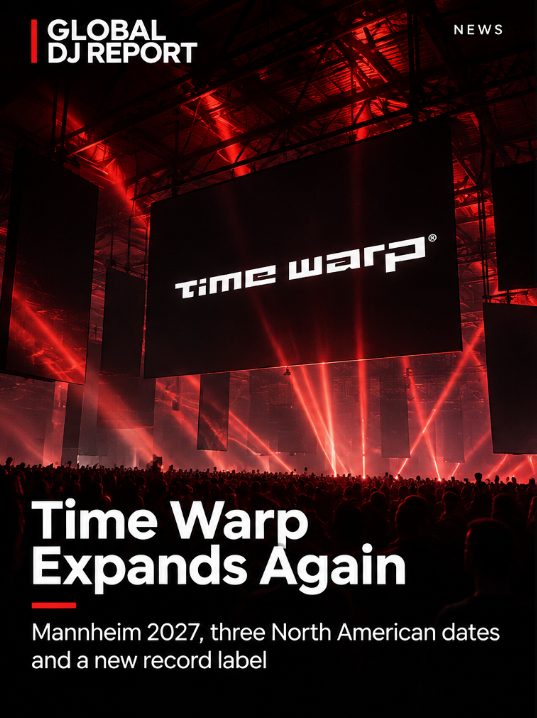
More than thirty years after its first edition, Time Warp is no longer simply one of Europe’s most important techno festivals.
It is becoming something much larger.
The German institution is closing 2026 with three major North American events, preparing its historic return to Mannheim in April 2027 and launching Time Warp Records, a new label designed to extend the brand’s musical identity beyond the festival floor.
The expansion arrives at a particularly interesting moment for electronic music.
Festival brands are increasingly becoming ecosystems.
Events become labels.
Labels create releases.
Artists become part of recurring communities.
And a project that began in one city can gradually develop its own international network.
Time Warp appears to be moving directly into that model.
Mannheim Remains the Centre
Despite the international expansion, Mannheim remains the symbolic home of Time Warp.
The 2027 edition will take place on April 3 at Maimarkthalle, with 49 artists across five floors and approximately 17 hours of music running from Saturday evening into Sunday afternoon.
The line-up brings together several generations of electronic music.
Among the confirmed artists are:
Charlotte de Witte
Sven Väth
Richie Hawtin
Nina Kraviz
Joseph Capriati
Loco Dice
I Hate Models
Indira Paganotto
Mau P
Seth Troxler
Maceo Plex
Rhadoo
Josh Baker
The programme also includes a significant number of collaborative sets.
B2Bs Become Part of the Identity
Time Warp has increasingly used back-to-back performances as a way to create moments that cannot simply be reproduced at another festival.
For Mannheim 2027, those combinations include:
Cloudy B2B KI/KI
Carlita B2B Rossi
Beltran B2B Ben Sterling
Ben Klock B2B Rødhåd
Ben UFO B2B Enzo Siragusa
Perhaps the most unusual booking is the first-ever three-way set bringing together Alarico, Chlär and Yanamaste.
These combinations reinforce something Time Warp has always understood.
A festival line-up is not only about collecting famous names.
The way those names interact can become part of the programming itself.
From Techno History to the New Generation
Time Warp was founded in 1994 and has built its reputation around the relationship between sound, architecture, lighting and long-form DJ performances.
Its current bookings show how the brand continues to balance that history with newer movements.
Sven Väth and Richie Hawtin represent figures deeply connected to European techno history.
Charlotte de Witte, I Hate Models and Indira Paganotto reflect the rise of larger-scale contemporary techno.
Josh Baker, Mau P, Rossi and Ben Sterling bring different forms of House, Minimal and Tech House into the programme.
The result is not one narrow interpretation of underground electronic music.
It is a snapshot of several scenes currently sharing the same international circuit.
North America Becomes a Major Focus
Before Mannheim returns, Time Warp will close 2026 with an unusually aggressive North American schedule.
Two events take place simultaneously on November 20 and 21.
One is the brand’s return to New York, where Time Warp reaches its ninth edition across the Duggal Greenhouse and Agger Building in Brooklyn.
The other is the first Time Warp Mexico, taking place at Expo Santa Fe in Mexico City.
Then, on November 27 and 28, the festival makes its first appearance in Los Angeles.
Time Warp Los Angeles Opens a New Venue
The Los Angeles edition is particularly significant.
Time Warp will take over ACE*Mission Studios, using warehouse spaces that have never previously hosted an electronic music event.
The festival will run across two days and three stages, bringing more than 30 House and Techno artists into the industrial complex.
The line-up includes:
Ben Klock
Richie Hawtin
Loco Dice
The Martinez Brothers
East End Dubs
SOSA
Chlär
Rødhåd
HAAi
Tiga
Funk Tribu
alongside several B2Bs and collaborative performances.
The decision to use a previously inactive warehouse environment feels particularly appropriate for Time Warp.
The brand has always treated the physical space as part of the experience rather than simply as a container for the lineup.
A Festival Brand Becomes a Record Label
The most important structural development may actually happen away from the festival.
On November 20, Time Warp will officially launch Time Warp Records.
The first release will be “Rings of Light” by Sven Väth and Roman Flügel, available digitally and on vinyl.
The collaboration is a strong opening statement.
Both artists are deeply connected to German electronic music history, and both have maintained careers built around musical identity rather than short-term trends.
The track was recorded in Berlin and becomes the first entry in a catalogue that Time Warp intends to develop over the coming years.
Why a Time Warp Label Makes Sense
The move into recorded music feels almost inevitable.
For more than three decades, Time Warp has curated a particular relationship between artists, audience and production.
But until now, that identity primarily existed during events.
A record label changes that.
The brand can now release music that reflects the sound heard across Mannheim, New York, São Paulo, Madrid, Mexico City or Los Angeles.
The festival becomes a continuous musical platform rather than something that disappears when the lights turn on.
Festival Brands Are Becoming Media Ecosystems
This is part of a broader shift across electronic music.
Major event brands increasingly operate beyond ticket sales.
They release music.
Create radio shows.
Produce documentaries.
Develop merchandise.
Build artist communities.
Launch international editions.
The strongest festival identities are becoming cultural platforms.
Time Warp has the history required to make that transition credibly.
It does not need to invent a musical identity for the label.
That identity has been developing since 1994.
Sound and Production Still Come First
Time Warp’s official philosophy remains closely tied to what it calls a “Synthesis of Light & Sound.”
That phrase explains much of the brand’s longevity.
Many festivals compete primarily through headliners.
Time Warp has consistently treated production as part of the artistic programme.
Each Mannheim floor has its own sound system, lighting concept and visual environment.
The architecture changes the music.
A DJ playing in one room can create a completely different experience from the same artist performing elsewhere.
Three Decades and Still Expanding
Time Warp could easily have become a heritage festival.
A brand built around nostalgia.
Instead, 2026 and 2027 suggest the opposite.
New cities.
New warehouses.
New artist combinations.
A new record label.
And another 49-artist Mannheim edition.
The expansion is ambitious, but the central idea remains remarkably consistent.
Long sets.
Serious sound systems.
Artists with strong identities.
Spaces designed around music rather than spectacle alone.
After more than thirty years, Time Warp is no longer just protecting its history.
It is trying to build the next part of it.