
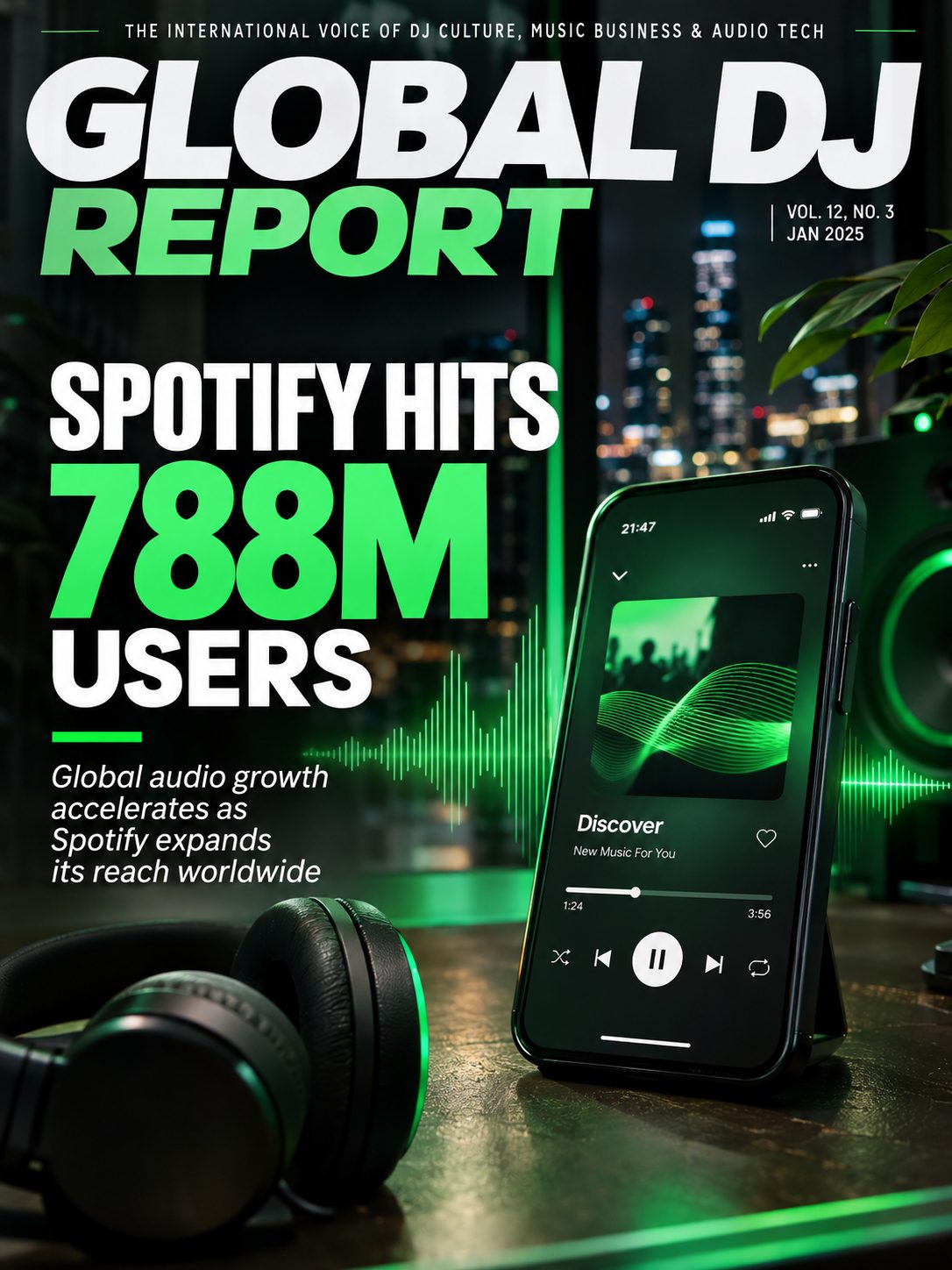
Spotify has entered the final part of 2026 with some of the strongest numbers in its history.
In its latest quarterly results, the streaming platform reported 788 million monthly active users, including 306 million Premium subscribers, confirming its position as one of the largest global platforms in music and audio. Revenue for the third quarter reached €5.0 billion, up 16% year-on-year, while operating income rose to €672 million.
For the music industry, those figures matter for reasons that go far beyond Spotify’s own balance sheet.
Every increase in users changes the scale at which artists, labels and distributors compete for attention.
And at nearly 800 million monthly listeners, Spotify is operating at a level where even relatively small changes to recommendation systems, playlists, discovery tools or monetisation can have global consequences.
306 Million Paying Subscribers
The most important number may be the 306 million Premium subscribers.
Spotify says that figure increased by 9% year-on-year, with subscriber growth recorded across every region. Monthly active users rose even faster, increasing by 11%.
This expansion shows that streaming continues to grow even after becoming the dominant way much of the world consumes music.
That is significant.
Several years ago, one of the main questions surrounding streaming was whether platforms would eventually reach saturation in mature markets.
Spotify’s current trajectory suggests that international expansion and new services are still creating additional room for growth.
The company now operates across 184 markets and gives users access to more than 100 million tracks, alongside podcasts and audiobooks.
Music Is No Longer the Only Part of Spotify
Spotify’s transformation into a wider audio platform continues to accelerate.
The company has announced that audiobook access will expand from 22 markets to more than 180 markets by the end of 2026, potentially bringing the service to more than 750 million people.
Its creator ecosystem is expanding as well.
The Spotify Partner Program is moving into more than 35 additional markets, while new Membership tools are designed to allow eligible creators to offer exclusive content and experiences directly to their audiences.
For musicians, this broader ecosystem creates both opportunity and competition.
Spotify is still fundamentally associated with music.
But music now exists inside a platform increasingly filled with podcasts, video, audiobooks and creator-driven products.
The fight for attention therefore extends beyond other artists.
It extends across different forms of entertainment.
Discovery Is Becoming More Personal
Spotify is also continuing to invest heavily in personalisation.
One of its recent developments is Taste Profile, a beta feature that allows users to see how Spotify understands their interests and influence the recommendations they receive.
The company has also introduced Playlist Notes, allowing listeners and editors to add context directly inside playlists.
These features may look relatively small compared with headline financial figures, but they point toward one of the most important questions in modern music distribution.
Who controls discovery?
In the physical era, that role often belonged to record stores, radio stations, magazines and DJs.
In streaming, algorithms and editorial playlists have become central.
The more personalised those systems become, the more powerful they are in determining which artists reach particular audiences.
Independent Artists Remain Part of the Strategy
Spotify is also expanding its Fresh Finds Forward initiative.
The company says the programme will provide resources, community and support to approximately 10,000 emerging independent artists every year.
That is a notable figure.
Independent distribution has made it easier than ever to release music, but access does not automatically create visibility.
Millions of tracks compete for listener attention.
The challenge is increasingly not getting music onto a streaming service.
It is being discovered once it arrives there.
Programmes focused on emerging artists therefore sit at the centre of one of streaming’s biggest tensions: open access versus limited attention.
Nearly 800 Million Listeners Changes the Scale
Spotify’s current user base demonstrates just how large streaming has become.
At 788 million monthly users, the platform is approaching a symbolic 800-million mark that would have been difficult to imagine when Spotify launched in 2008.
But scale creates responsibility as well as opportunity.
Artists increasingly depend on digital platforms for discovery.
Labels use streaming data to guide marketing and release strategies.
Promoters can use audience information to understand where artists are gaining traction.
Listeners rely on recommendation systems to navigate a catalogue too large to explore manually.
Spotify sits at the centre of all of those relationships.
Streaming Is Becoming Infrastructure
Perhaps the most important way to understand Spotify in 2026 is no longer simply as a music application.
It has become infrastructure.
A new artist can upload a track and potentially reach listeners across dozens of countries within hours.
A record label can analyse audience growth almost in real time.
A song that gains momentum on a playlist can influence touring, radio, social media and even festival bookings.
The streaming platform has therefore become deeply integrated into nearly every part of the modern music business.
Its third-quarter results show that this infrastructure is still expanding.
788 million active users.
306 million subscribers.
€5 billion in quarterly revenue.
The numbers are enormous.
But for artists and electronic music culture, the more interesting question is what happens when nearly 800 million people are connected to the same global discovery system.
That answer will shape far more than Spotify itself.