
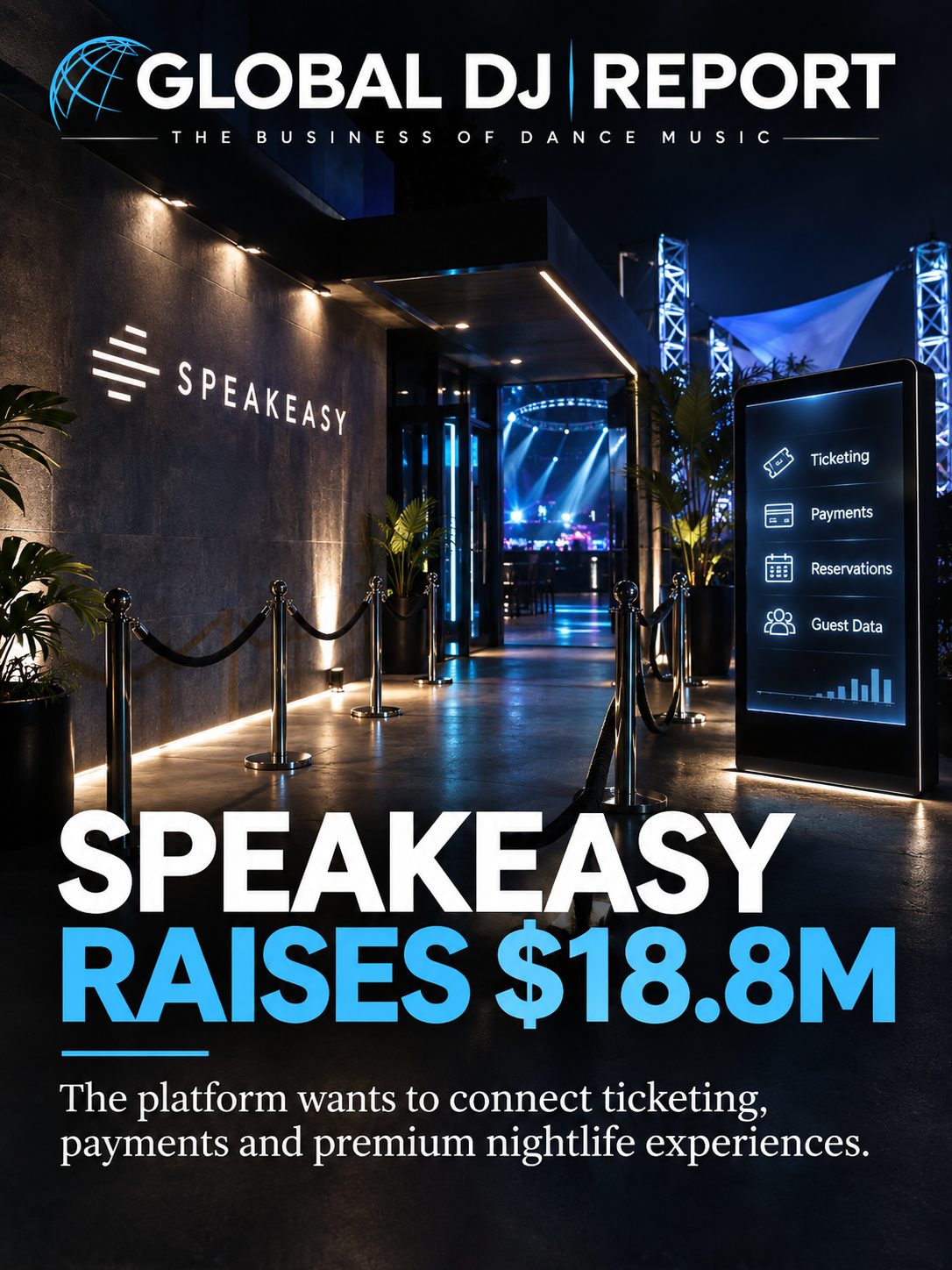
The future of nightlife may depend as much on software as it does on sound systems.
Speakeasy, a New York technology company focused on live entertainment and hospitality, has raised $18.8 million in an oversubscribed Series A funding round, bringing its total funding to approximately $27 million.
The round was led by VMG Technology, with participation from Capital One Ventures, Positive Sum and Yamaha Music Innovations Fund.
For electronic music, the announcement is particularly relevant.
Speakeasy is trying to solve one of the least glamorous but most persistent problems in nightlife:
fragmentation.
A fan buys a festival ticket through one platform.
Books a VIP table through another.
Joins an afterparty guest list somewhere else.
Pays at the venue using another system again.
Each interaction generates valuable information.
But often none of the systems communicate with one another.
Speakeasy wants to change that.
One Platform for the Entire Night
The company combines several functions inside a single infrastructure.
Ticketing.
Reservations.
Payments.
Premium experiences.
Guest data.
CRM.
Direct marketing.
Instead of treating each transaction as a separate interaction, the platform attempts to build a unified view of the guest.
That could become extremely valuable for festivals and clubs.
Imagine a fan attending a two-day electronic music festival.
They buy the ticket.
Upgrade to VIP.
Reserve a table at the official afterparty.
Spend money at a partner venue.
Return for another event several months later.
Traditional systems may see those actions as unrelated.
A unified platform can potentially understand them as one customer journey.
That changes the relationship between promoter and audience.
The Clients Already Include Major Nightlife Names
Speakeasy is not building only for small venues.
Its customer base already includes brands such as:
TAO Group Hospitality
Fontainebleau Development
E11EVEN
Breakaway Music Festival
Resorts World
Cipriani
Barstool
Off Grid @ F1
The company says its platform is currently used by live-experience operators across more than 45 US cities.
That client list is important.
It shows the platform operating across several different forms of nightlife.
Nightclubs.
Festivals.
Luxury hospitality.
Restaurants.
Premium events.
The common denominator is not one specific venue type.
It is the guest experience.
Festivals and Clubs Have the Same Data Problem
Electronic music events generate huge quantities of behavioural information.
Who buys early.
Who buys late.
Who upgrades.
Who returns.
Who spends more inside the venue.
Who attends several events from the same promoter.
Who travels from another city.
But much of that information remains trapped inside separate systems.
Speakeasy’s strategy is to consolidate those interactions.
CEO and co-founder Alex Manavi argues that live-experience businesses have historically used fragmented tools that never captured the full relationship between guest and operator.
This is particularly relevant to club culture.
A promoter may recognise their regular customers physically.
Software often does not.
AI Is Part of the Next Phase
Part of the new funding will be used to accelerate AI capabilities inside the platform.
The company plans to use artificial intelligence to help operators price experiences, personalise offers and automate operational workflows.
That could eventually influence several areas of nightlife.
Dynamic pricing.
Audience segmentation.
Event recommendations.
VIP offers.
Guest communication.
Marketing timing.
Customer retention.
The goal is not simply to sell one ticket more efficiently.
It is to understand which experience to offer that customer next.
Dynamic Pricing Could Become More Sophisticated
Ticket pricing in electronic music is already becoming increasingly dynamic.
Early bird.
First release.
Second release.
Final release.
VIP.
Backstage packages.
Tables.
Bottle service.
Premium zones.
Each tier reflects demand differently.
If one system can connect ticketing with historical guest behaviour, operators can theoretically become much more precise about pricing.
A frequent VIP customer may receive a different offer from someone attending for the first time.
A fan who attended several previous events may receive early access.
Someone who repeatedly purchases tables could be targeted differently from a standard ticket buyer.
That level of personalisation is normal in ecommerce.
Nightlife is only beginning to adopt it at scale.
The Rise of the ‘IRL Economy’
Speakeasy describes its target market as the IRL economy — in-real-life experiences.
The company points to data suggesting that between 2023 and 2025, the global experiences market grew more than three times faster than nonessential goods categories. It also cites projections showing global live music revenue increasing by $28 billion between 2025 and 2035.
The broader idea is simple.
As more daily life moves online, physical experiences may become more valuable.
People can stream music at home.
They can watch festival sets online.
They can discover almost any artist instantly.
But they cannot digitally reproduce the feeling of standing inside a club at 3 AM when the right record arrives.
The scarcity is increasingly physical.
Yamaha’s Investment Is Particularly Interesting
The participation of the Yamaha Music Innovations Fund makes the round especially relevant to the music industry.
This is not purely hospitality technology.
One of the world’s major music technology companies sees value in the infrastructure surrounding physical experiences.
That suggests an increasingly broad definition of music technology.
Music tech is no longer only:
synthesizers,
DJ equipment,
production software,
or streaming platforms.
It can also mean the operating systems behind venues and festivals.
The Business of Nightlife Is Becoming More Professionalised
Electronic music culture often celebrates spontaneity.
But behind every successful event is an increasingly complex business.
Ticketing.
Security.
Payments.
Marketing.
Guest lists.
Hospitality.
Customer support.
Artist operations.
VIP management.
Data.
The largest promoters already manage these areas with sophisticated systems.
Platforms such as Speakeasy aim to make similar infrastructure available across a wider part of the live-experience industry.
That could change how smaller operators compete.
The Club as a Customer Relationship
This is perhaps the most important shift.
Historically, clubs often thought in terms of nights.
Friday.
Saturday.
Special event.
Next event.
Technology increasingly encourages them to think in terms of people.
Who attended Friday?
Did they return?
What else did they buy?
Which artist brought them?
Which genres do they respond to?
Which other events might interest them?
That changes programming as well as marketing.
If promoters understand their audience better, they can make more informed booking decisions.
Data Creates Opportunity — and Responsibility
There is also another side to this model.
Consolidating guest information creates much deeper customer profiles.
Ticket purchases.
Reservations.
Spending.
Attendance.
Preferences.
Potentially several years of behaviour.
That can make the experience smoother.
It also makes data governance increasingly important.
Who controls that information?
How is it used?
How much personalisation becomes too much?
The nightlife industry will need to confront the same privacy questions already facing ecommerce and social platforms.
Electronic Music Is Becoming an Infrastructure Business
The electronic music industry used to be built largely around a small number of core businesses.
Records.
Clubs.
Promoters.
Booking agencies.
Today, the ecosystem is much wider.
Ticketing technology.
Streaming.
Audience analytics.
Rights management.
Creator software.
Payments.
CRM.
AI.
Fan data.
Speakeasy belongs to this new layer.
It does not make the music.
It does not book the DJ.
It does not build the stage.
But it wants to connect everything that happens around those experiences.
Why $18.8 Million Matters
The funding amount is significant because it signals investor confidence in nightlife technology.
VMG Technology, Capital One Ventures, Positive Sum and Yamaha are effectively making the same bet:
people will continue paying for real-world experiences, and the infrastructure behind those experiences needs improvement.
If that prediction is correct, the next major competition in nightlife may not be only between clubs.
It could also be between the software platforms powering them.
The Future Club May Know You Before You Arrive
This is where the story becomes especially interesting.
A future festival could recognise a returning guest before they buy.
Recommend the right ticket.
Suggest an afterparty.
Offer a table.
Remember their previous purchases.
Then keep that relationship active after the event.
None of those ideas is particularly futuristic individually.
What changes is putting them together.
Speakeasy wants to become the system connecting all of them.
For dance music fans, the visible experience may remain exactly the same.
A dark room.
A loud sound system.
A DJ.
A crowd.
But behind that simplicity, nightlife is becoming increasingly technological.
And the next revolution in club culture may happen somewhere the audience never sees:
inside the software running the night.