
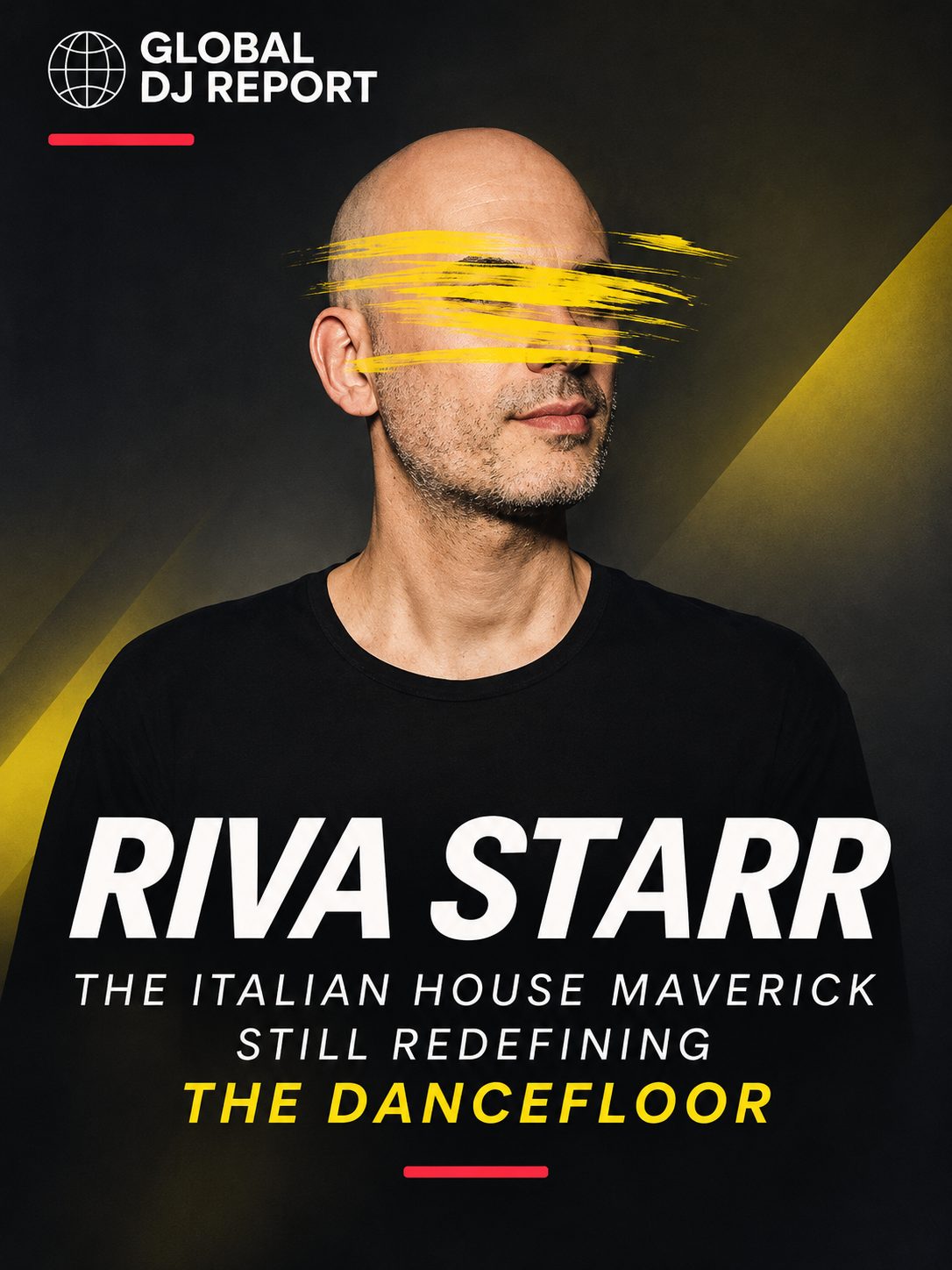
Few Italian electronic artists have managed to move so freely between underground house culture, major festivals and left-field experimentation as Riva Starr.
Born Stefano Miele and now based in East London, Riva Starr has spent nearly two decades developing a career defined less by one fixed genre than by a restless relationship with the dancefloor.
House remains the centre.
But around it, he has continuously absorbed funk, soul, tech house, jazz, breakbeat, disco and more experimental club influences.
That flexibility has allowed him to perform everywhere from Glastonbury and Fuji Rock to Tomorrowland, while continuing to release through labels deeply connected to underground electronic music.
In 2026, that ability to move between worlds feels as relevant as ever.
From Stefano Miele to Riva Starr
Riva Starr began releasing under his current alias in the second half of the 2000s after earlier activity in the breakbeat scene.
His development coincided with a period when European house music was becoming increasingly fragmented.
Minimal was growing.
Tech house was changing.
Electro influences were entering club sets.
And producers were beginning to move much more freely between genres.
Riva Starr fit naturally into that environment.
Instead of building an identity around one rigid formula, he developed a production style based on curiosity.
That approach eventually led to releases on labels including Dirtybird, Hot Creations, Crosstown Rebels, Truesoul, Moon Harbour, Saved and Cajual, alongside his own Snatch! Records.
Snatch! Records and the Artist Behind the Label
Riva Starr is not only a DJ and producer.
He is also the founder of Snatch! Records, a label that became an important extension of his artistic identity.
The imprint has been used to release club music that sits between house, tech house and more unpredictable forms of underground electronic production.
Snatch! has also grown beyond the catalogue itself.
The brand has hosted stages and takeovers at major festivals including Creamfields and Tomorrowland, giving Riva Starr a platform that connects records directly with physical club culture.
That relationship between artist and label is central to understanding his career.
Riva Starr does not simply make tracks.
He builds environments around them.
A Career Built on Collaboration
Collaboration has always played a major role in Riva Starr’s work.
Across his career, he has worked with artists from very different musical worlds, including Horace Andy, Fatboy Slim, Green Velvet, Arthur Baker and Jocelyn Brown, while also remixing names far outside conventional house music.
That openness continued strongly in 2026.
In September, Riva Starr joined Australian duo Close Counters for the four-track Push Your Luck EP on Heist Recordings.
The project combined Starr’s house background with the duo’s jazz, funk and live-performance approach, while vocalist Andre Espeut featured across the release.
Rather than forcing either side into the other’s style, the EP allowed both identities to remain visible.
That is one of Riva Starr’s strongest characteristics.
He collaborates without disappearing.
‘Whole Room Dancing’ With Adam Port
October brought another major release.
Riva Starr teamed up with Adam Port and JRM for “Whole Room Dancing,” released through Vinyl On Demand.
The collaboration connects two producers whose musical relationship stretches back more than a decade.
Riva Starr had previously remixed Adam Port and Santé’s “Own” in 2010, with further exchanges developing through Snatch! Records and later remix work.
The 2026 single became their first official joint production.
And the concept behind it is particularly interesting.
Adam Port introduced the track around a simple question: can a record still dominate the dancefloor without using a conventional pre-produced DJ break?
The title gives away the answer they are looking for.
The whole room should dance.
Not wait for the drop.
Groove Before Formula
That idea fits perfectly with Riva Starr’s career.
His strongest records have rarely depended on one obvious structural trick.
They work because of rhythm.
A vocal enters.
A bassline shifts.
Percussion becomes more aggressive.
The groove gradually changes shape.
The track continues moving without stopping to explain itself.
This philosophy has helped him remain relevant across several different phases of house and tech house.
Production trends changed.
The dancefloor remained the reference point.
From Underground Clubs to Global Festivals
Riva Starr’s touring history demonstrates how successfully that sound has travelled.
His official biography lists performances at festivals including Glastonbury, Fuji Rock and Tomorrowland, while his wider career has also included appearances across Ibiza and major international club circuits.
The important part is that the scale of those events has never completely changed the music he represents.
There are records capable of working in a festival environment.
There are others built for smaller underground rooms.
Riva Starr’s catalogue has always contained both.
That flexibility is increasingly rare.
Many artists build a sound around a specific environment.
Riva Starr builds around the idea of movement itself.
2026 Shows Another Side of the Story
His current catalogue reinforces that point.
Beatport lists “Whole Room Dancing” as his latest 2026 release, following Push Your Luck, contributions to PIV’s Footprints LP and his warehouse-focused reinterpretation of salute’s “soulreply.”
These releases do not all belong to exactly the same stylistic space.
And that is intentional.
Riva Starr has spent years refusing to reduce himself to one sound.
House is the foundation.
Tech house is part of the language.
But funk, soul, jazz and more experimental ideas continue to enter the conversation.
An Italian Artist With a Global Identity
Riva Starr represents an interesting version of Italian electronic music.
His roots are Italian.
His career became international.
His home is London.
His catalogue belongs to a global club culture.
That combination has allowed him to develop outside the limitations of one national scene while retaining the creative unpredictability that made him stand out in the first place.
For nearly two decades, Riva Starr has continued to ask the same fundamental question in different ways:
What makes people move?
The answer keeps changing.
That may be exactly why his career has lasted.