
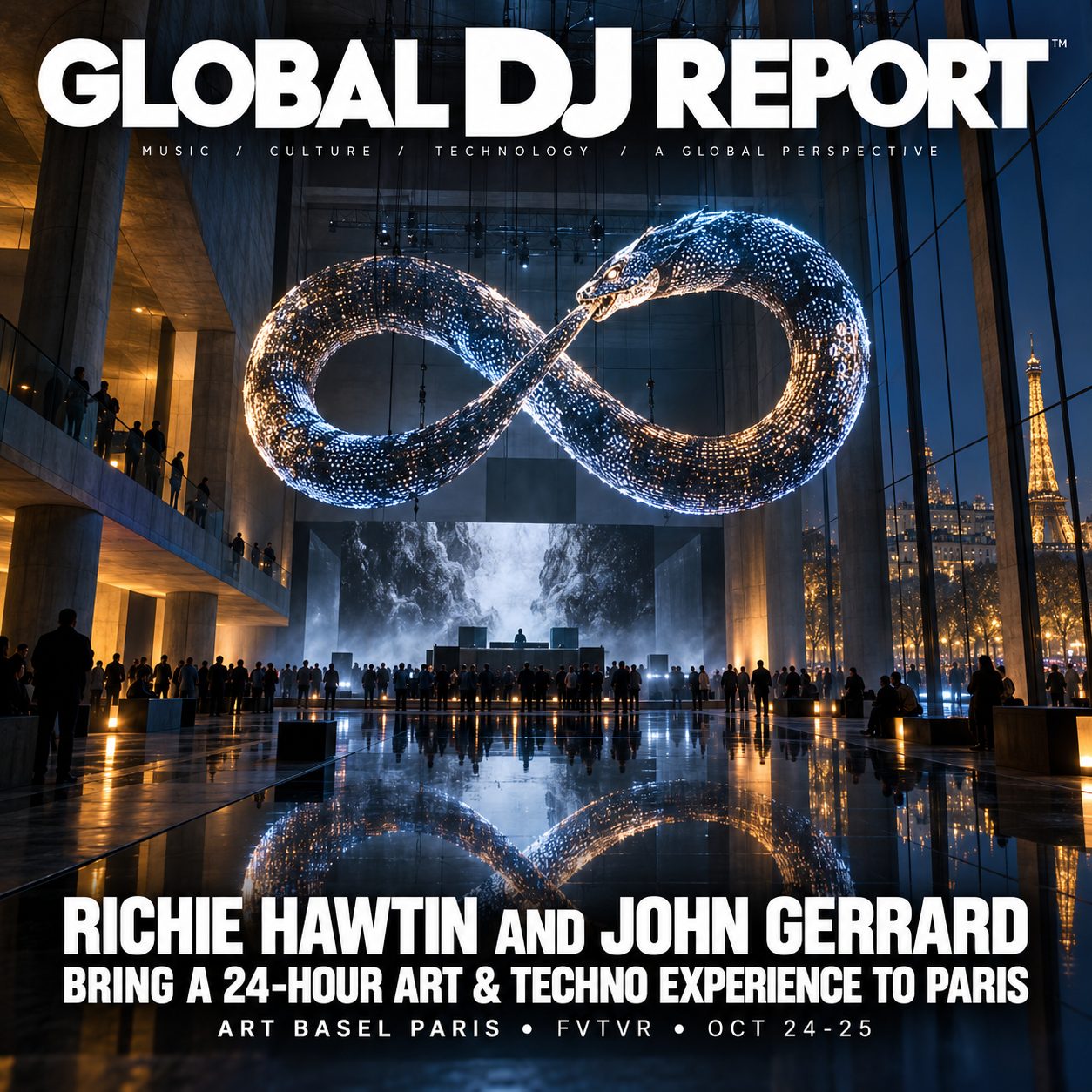
Richie Hawtin is preparing one of the most ambitious projects of his recent career.
On October 24 and 25, the electronic music pioneer will join contemporary digital artist John Gerrard at FVTVR in Paris for a continuous 24-hour programme combining installation art, generative sound, conversation and club culture during Art Basel Paris 2026. Electronic Groove
The event is divided into two main chapters.
From midday on October 24 until midnight, Gerrard will present INFIN.1.IRIDESCENT.STREAM, a digital installation accompanied by an original composition created by Plastikman, Hawtin’s long-running experimental alias, together with Bronze.ai. Entry to this first part of the programme is free. Electronic Groove
At midnight, the experience changes completely.
FVTVR will move from gallery-like contemplation into a twelve-hour club programme titled MINUS+ / SPIRITS, curated by Hawtin and running until noon on October 25.
The line-up features Richie Hawtin, Matador, Courtesy, Kristin Velvet and Reece Pritchard, while Gerrard’s visual work continues alongside the music through a live presentation of SPIRITS. Resident Advisor
From Installation to Dancefloor
The structure of the project is what makes it particularly interesting.
Most electronic music events separate performance from exhibition.
Here, the transition is built into the event itself.
The first twelve hours are designed around observation, sound and slow transformation. Then, at midnight, the same wider artistic dialogue moves into the collective environment of a club.
That progression feels particularly appropriate for Hawtin.
Throughout his career, he has repeatedly explored the relationship between technology, minimalism and perception, both through his DJ work and through the more experimental language of Plastikman.
Gerrard approaches similar questions through digital simulation.
His work often uses virtual environments that evolve slowly over extended periods of time, making duration itself part of the artwork.
INFIN.1.IRIDESCENT.STREAM
Gerrard’s installation follows a digital python moving through a simulated world.
At regular intervals, the snake forms a figure-eight shape and closes into an ouroboros, the ancient symbol associated with cycles of destruction and renewal. The visual environment changes according to a full simulated solar year. When We Dip
Plastikman’s accompanying sound composition does not simply loop underneath the image.
It is continuously recomposed using Bronze.ai, meaning the audio evolves together with the visual work rather than remaining fixed. When We Dip
The event will also open with a conversation between Hawtin and Gerrard moderated by Marc Spiegler, focusing on the ideas and processes behind the collaboration. Electronic Groove
MINUS+ After Midnight
When the installation’s daytime section ends, the focus turns fully toward the club.
The twelve-hour MINUS+ programme extends Hawtin’s long-standing interest in minimal and techno culture, but places it inside the wider framework of the artwork.
Matador, Courtesy, Kristin Velvet and Reece Pritchard join Hawtin across the night, while Gerrard’s SPIRITS continues the connection between image, material and electronic sound. When We Dip
SPIRITS itself is based on digitally reconstructed plastic footwear collected from shorelines around different parts of the world, transforming discarded objects into continually shifting virtual sculptures. The work was originally commissioned through the Los Angeles County Museum of Art’s Art + Technology Lab. When We Dip
Club Culture Moves Into the Art World
The project arrives at a moment when electronic music is increasingly being presented outside traditional nightlife contexts.
Museums, galleries and major art fairs have become more interested in the language of clubs, while electronic artists are increasingly creating work that cannot be reduced to a conventional DJ set.
Hawtin and Gerrard’s 24-hour programme sits directly inside that shift.
It does not treat the club as an afterparty to the art.
Instead, the dancefloor becomes one of the forms through which the work is experienced.
For Art Basel Paris, that may be the most interesting idea of all.
The audience begins by watching.
Twelve hours later, it becomes part of the movement.