
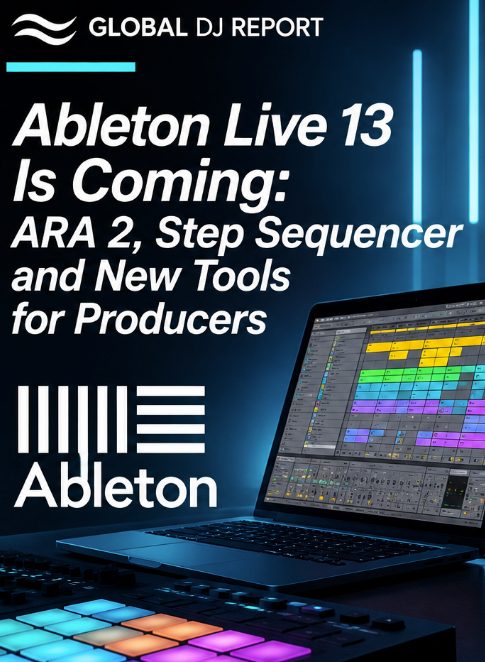
Ableton has officially announced Live 13, the next major version of its music production and performance software.
The update is scheduled for release in early 2027 and is already available in public beta, introducing a series of changes aimed at producers, live performers and electronic musicians who use Live as the centre of their creative workflow.
The headline additions include ARA 2 support, a new Step Sequencer, expanded Rack functionality, new sound-design tools, updated mixing devices and deeper integration with Push 3.
For electronic music producers, this is not a cosmetic update.
Several of the new features directly affect the way audio can be edited, programmed and manipulated inside a project.
ARA 2 Finally Arrives in Ableton Live
One of the most significant additions is ARA 2 support.
ARA, short for Audio Random Access, allows compatible plug-ins to interact much more deeply with audio inside a DAW.
Instead of constantly transferring or recording audio into an external editor, supported plug-ins can work directly with audio clips in the Arrangement View.
Ableton’s beta documentation confirms that ARA plug-ins can now be loaded directly onto audio clips and take lanes, with edits later bounced back into the project when needed.
For producers working heavily with vocals, timing correction or detailed pitch editing, this could be one of Live 13’s most important workflow changes.
Ableton also says Live 13 Suite will include Melodyne essential, giving users an immediately available ARA-compatible environment for vocal and audio correction.
Step Sequencer Brings a Different Way to Build Patterns
The second major addition is a new Step Sequencer.
Ableton describes it as a more playful way to create MIDI patterns, allowing producers to develop beats and melodic sequences in a more direct and visual manner.
Step sequencing is hardly new to electronic music.
Drum machines, grooveboxes and hardware sequencers have used the concept for decades.
But integrating a deeper step-based workflow directly into Live gives producers another alternative to conventional piano-roll programming.
For House, Tech House, Techno and Minimal producers, this could be especially useful.
Percussion often depends on extremely small rhythmic decisions.
One shifted hi-hat.
One delayed clap.
One ghost note.
A sequencer that encourages pattern-based experimentation can make those decisions faster and more intuitive.
Drum Synth and Looplet Expand Sound Design
Live 13 also introduces new devices designed around sound creation.
Drum Synth allows users to build percussion sounds from scratch rather than relying only on samples.
Looplet, meanwhile, is designed to generate layered and evolving textures from a single sample.
These additions fit naturally into Ableton’s broader philosophy.
Live has always been strong at transforming simple source material into something more complex.
A short sample can become a pad.
A vocal fragment can become percussion.
A single drum hit can become an evolving rhythmic texture.
Looplet appears to push further in that direction.
Mixing Gets More Precise
The update is not limited to composition.
Ableton is also introducing several tools focused on mixing and dynamics.
New devices include Transient Shaper and Clipper, while expanded Rack functionality makes it possible to split processing across different frequency ranges or stereo areas using Multiband and Mid-Side Racks.
For club-focused production, these tools can become particularly important.
Kick drums and basslines often compete for the same low-frequency space.
Percussion needs attack without becoming harsh.
Masters need loudness without destroying movement.
Transient shaping and clipping are already central techniques in modern electronic production.
Having more of those tools available natively could reduce the need for third-party plug-ins in many workflows.
Contextual Browsing Changes the Device Workflow
Another interesting addition is Contextual Browsing.
Ableton says Live 13 will make it easier to add devices and swap presets directly from the device chain.
This sounds like a smaller change compared with ARA 2 or the new sequencer, but workflow improvements can have a major impact over time.
Producers spend enormous amounts of time searching.
Searching for samples.
Searching for presets.
Searching for effects.
Searching for the right device.
Anything that reduces those interruptions can make the creative process feel more continuous.
Capture Automation Preserves Unrecorded Movements
Live 13 also adds Capture Automation.
The feature is designed to preserve gestures made before recording was explicitly enabled.
That is particularly relevant for electronic musicians who work through improvisation.
A producer may move a filter.
Change a parameter.
Build tension through an effect.
Then realise the movement was actually worth keeping.
Capture Automation is designed to recover that kind of spontaneous performance.
In a DAW increasingly used as an instrument as much as a recording environment, that makes sense.
Push 3 Becomes More Customisable
Push is also receiving substantial changes alongside Live 13.
One of the most important is Custom Layouts.
Users can now configure the Push 3 pad surface by combining note areas, clip launching, faders and XYZ controls inside a single layout. Up to eight custom layouts can be stored per Set.
That gives live performers considerably more freedom.
Instead of adapting their performance style to one fixed controller layout, they can design the controller around the needs of each project.
Push also gains its own physical implementation of the new Step Sequencer, alongside improved device navigation and a Performance Mixer.
A Refreshed Core Library
Ableton has also rebuilt much of Live’s factory content.
The beta release notes list more than 45 Drum Racks, over 180 instrument presets, more than 260 Audio Effect Racks and device presets, around 160 MIDI clips and over 270 new samples.
The company says the philosophy behind the update is fewer, fresher presets with clearer naming.
This is another sign that Ableton is focusing not only on adding features, but also on reducing friction.
A giant library is not always useful if nobody can find anything inside it.
Live 12 Owners and the Upgrade Path
Ableton has also announced a transitional offer around the update.
Live 12 editions and upgrades are currently discounted by 20% until Live 13 is released, and qualifying purchases will include a free upgrade to the corresponding Live 13 edition.
Push 3, Move and the Push Upgrade Kit are also discounted by 20% for a limited period.
Ableton has not yet announced the exact Live 13 release date, only confirming early 2027.
More Than a Version Number
The most interesting thing about Live 13 is not one individual feature.
It is the direction of the update.
Ableton appears to be focusing on three areas simultaneously:
faster experimentation,
deeper sound design,
and more precise finishing.
ARA 2 improves editing.
Step Sequencer improves pattern creation.
Drum Synth and Looplet expand sound design.
Transient Shaper and Clipper strengthen mixing.
Push becomes more flexible as a performance instrument.
These are not disconnected additions.
They all point toward a workflow where producers can move from idea to finished track with fewer interruptions.
For electronic music producers, Ableton Live has long been more than a DAW.
It is also a performance environment, sampling instrument, sequencing platform and live system.
Live 13 appears designed to make those identities work more closely together.
The public beta is already open.
The full release arrives in early 2027.
And for producers whose studio revolves around Ableton, the next generation of Live has officially begun.