
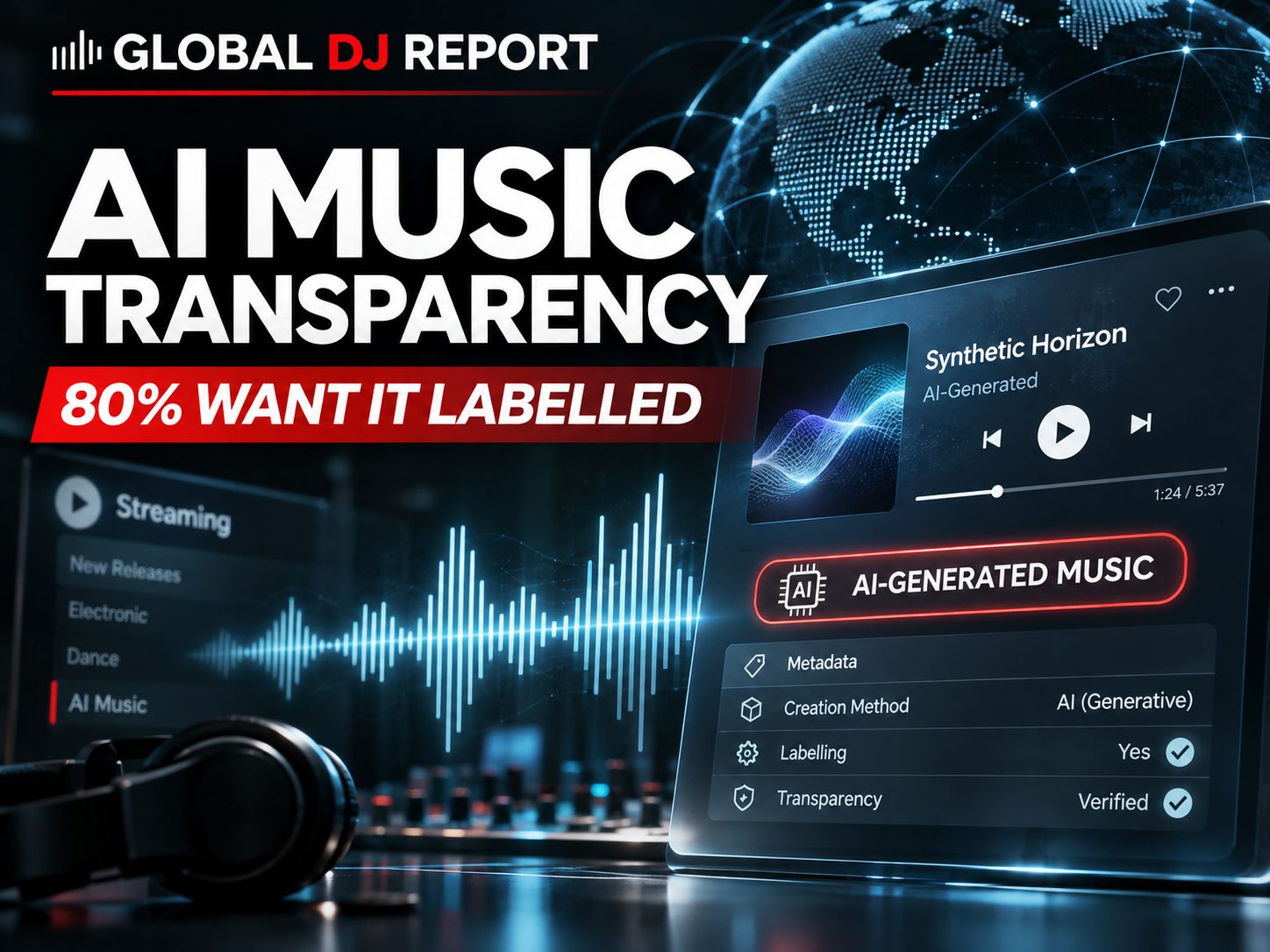
Artificial intelligence is no longer a future issue for the music industry.
It is already inside streaming platforms.
Inside production tools.
Inside mastering software.
Inside songwriting workflows.
And, increasingly, inside the music listeners encounter every day.
A new international study commissioned by Deezer and conducted by Ipsos suggests that audiences are becoming much more demanding about one specific issue:
transparency.
According to the research, 80% of respondents across eight countries believe fully AI-generated music should be clearly labelled, while the same percentage also wants labels applied to music created with significant AI assistance.
The result is significant because the debate around AI music is beginning to move beyond whether the technology should exist.
Listeners increasingly appear to be asking a different question.
If AI is involved, should they be told?
9,000 People Across Eight Markets
The study surveyed approximately 9,000 adults across the United States, Canada, Brazil, the United Kingdom, France, the Netherlands, Germany and Japan.
The research was conducted between October 9 and October 14, 2026, with 6,672 respondents identifying themselves as music streaming users.
The findings show considerable agreement across very different markets.
People may have different opinions about whether AI is useful.
They may disagree about whether it improves music.
But when it comes to identifying AI content, support for transparency is extremely high.
That creates a potentially important signal for streaming platforms.
Fully AI-Generated and AI-Assisted Are Not the Same Thing
One of the most interesting elements of the survey is that listeners appear interested in transparency not only for fully machine-generated tracks.
They also want information about AI-assisted music.
That distinction matters.
Modern production already contains many forms of artificial intelligence.
AI can help separate stems.
Clean recordings.
Correct vocals.
Generate sounds.
Assist with mastering.
Suggest chords.
Create samples.
Or produce complete songs from text prompts.
These uses are not equivalent.
A producer using AI-assisted noise reduction is very different from a platform generating an entire artist, voice and composition without meaningful human involvement.
The challenge for the industry is deciding where one category ends and another begins.
Deezer Is Already Detecting AI Music
Deezer has become one of the most aggressive major streaming services in attempting to identify fully AI-generated material.
The company says it is now receiving nearly 90,000 fully AI-generated tracks every day, representing more than half of all daily deliveries on peak days.
That number illustrates the scale of the problem.
Streaming platforms were originally designed around human artists releasing music.
Generative systems can operate very differently.
A human producer might release several tracks in a month.
An automated system can potentially generate thousands.
The economics of music distribution change dramatically when production volume is no longer limited by human time.
More AI Music Is Already Inside Playlists Than Listeners Realise
There is also a major gap between perception and reality.
Among streaming users surveyed, 74% believed their playlists contained no fully AI-generated music.
However, Deezer says internal data from people joining its platform from other services showed that nearly 57% already had at least one fully AI-generated track inside their playlists.
Those figures come from different datasets, so they cannot be compared as a direct scientific measurement.
But the contrast is still striking.
Many listeners may simply not know when they are hearing AI-generated content.
That is exactly why labelling has become such an important part of the conversation.
The United States Is Becoming More Sceptical
The strongest change appears to be happening in the United States.
In 2025, 54% of American respondents agreed that AI could be a valuable tool for musicians, artists and composers.
In 2026, that figure dropped to 37%.
The percentage of US respondents expecting AI to play a significant role in music creation over the next decade also fell from 62% to 51%.
At the same time, 69% of US respondents now believe AI use could lead to a loss of creativity in music production.
The technology has not disappeared.
Public enthusiasm appears to be cooling.
AI Music and the Question of Trust
This may ultimately be less about technology than trust.
Listeners have always accepted technology inside music.
Synthesizers.
Drum machines.
Sampling.
Auto-Tune.
Digital editing.
Software instruments.
None of those tools destroyed the relationship between artist and audience.
But generative AI introduces another question.
Who actually created the work?
If a song is presented through a fictional artist, generated voice and generated composition, the listener may believe they are interacting with a human creative identity that does not really exist.
That changes the relationship.
Transparency becomes part of the artistic contract.
Should AI Tracks Compete in the Same Charts?
The survey also raises another major industry question.
60% of respondents said fully AI-generated songs should not appear in the same main music charts as human-created tracks.
That figure increased by eight percentage points compared with the previous year.
This could eventually become a major issue for chart companies.
If automated production can generate enormous volumes of music, should those tracks compete directly with human artists?
Would separate AI charts make more sense?
Or should charts remain neutral and measure only consumption?
There is no universal answer yet.
But audiences are clearly beginning to form opinions.
Streaming Recommendations Are Part of the Debate
Another important finding concerns algorithms.
Among streaming users, 72% said they want to know when a platform is recommending fully AI-generated music to them.
This goes beyond simple labelling.
It touches the recommendation system itself.
Streaming platforms increasingly decide which songs listeners encounter.
If a service begins recommending AI-generated music without clearly identifying it, users may feel that a major editorial decision has been hidden from them.
The algorithm is already powerful.
AI music makes that power even more sensitive.
Fraud Is Another Major Concern
Deezer has also connected generative AI with streaming fraud.
The company says that up to 85% of streams associated with fully AI-generated tracks in 2025 were fraudulent, and those manipulated streams were excluded from royalty payments.
This does not mean AI-generated music is automatically fraudulent.
But generative technology can make large-scale fraud easier.
Thousands of tracks can be created quickly.
Automated accounts can stream them.
Artificial content can generate artificial consumption.
If not detected, money can be redirected from legitimate artists toward fraudulent systems.
That makes AI detection an economic issue, not only an artistic one.
What Does This Mean for Electronic Music?
Electronic music has always had one of the strongest relationships with technology.
Producers embraced machines long before many other genres.
New production tools are generally treated with curiosity rather than fear.
For that reason, electronic music may become one of the most interesting testing grounds for AI.
AI-assisted tools will almost certainly become increasingly normal.
Stem separation already is.
Smart mastering already is.
Generative sound design is growing rapidly.
The more difficult question concerns fully generated artistic identities.
Would club audiences care if a track works on the dancefloor?
Would DJs care who created it?
Would labels sign fictional artists?
Would festivals book AI-generated acts?
These questions are no longer theoretical.
Human Creativity Is Not the Same as Human Purity
The conversation also needs nuance.
A demand for AI labelling does not necessarily mean listeners reject AI.
The survey found that 45% would accept their favourite artist using AI for production, mixing or mastering.
That suggests people understand the difference between using AI as a tool and replacing most of the creative process.
Music has never been technologically pure.
The issue is agency.
Who made the choices?
Who created the emotional intention?
Who is responsible for the final work?
The Industry Is Moving Toward Labels
Major rights organisations are already pushing for clearer standards.
The RIAA and IFPI have supported proposals distinguishing between “AI-generated” and “AI-assisted” recordings.
That two-level model could become increasingly important.
It allows the industry to recognise that using an intelligent production tool is not the same as generating an entire song automatically.
The implementation will be difficult.
But the terminology is beginning to form.
Listeners Want the Choice
Ultimately, the clearest message from the Deezer and Ipsos study is not that audiences want AI removed from music.
They want to know when it is there.
That difference matters.
Listeners may choose to hear AI-generated music.
Others may prefer to avoid it.
Deezer is preparing an option allowing users to filter fully AI-generated music from search results before the end of 2026.
Choice requires information.
Without labelling, there is no meaningful choice.
The Next Music Industry Standard May Be a Small Label
AI will continue evolving.
Production tools will become more powerful.
The distinction between human and machine workflows may become harder to identify.
That makes transparency increasingly valuable.
An AI label might appear visually small beside a song title.
But it could become one of the most important pieces of metadata in the streaming era.
For decades, music platforms told listeners who the artist was.
Who wrote the song.
Which label released it.
Whether the lyrics were explicit.
The next question may be equally simple:
how was this music made?